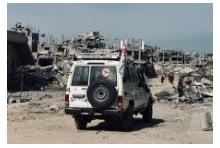
Supporting the Palestinian People: MSF’s Response in Gaza and the West Bank
di Medecins Sans Frontieres Australia
Médecins Sans Frontières (MSF) plays a vital role in Gaza. In 2025 we supported one in five hospital beds and assisted one in three mothers during childbirth. We continue to operate clinics for people with traumatic injuries and chronic illnesses, treat malnourished children or burn patients, and we distributed 700 million litres of water last year.
*Contributions to MSF through Benevity are directed towards our general fund, which is what we draw upon to deliver lifesaving healthcare wherever the needs are greatest.
We want to ensure we are accountable and using your gift where you intend, so please contact us if you would like to support our work in Gaza directly.*
The recent escalation in the Middle east has worsened humanitarian conditions in Gaza and the West Bank. Israel closed all crossings into Gaza at the end of February, suspending medical evacuations and preventing thousands of patients from accessing specialized treatment outside the territory. Although some crossings later reopened for limited supplies, Rafah remains closed and humanitarian access remains highly restricted.
In the West Bank, intensified military operations, increased settler violence, and checkpoint closures have limited movement between cities, delaying access to healthcare and disrupting humanitarian operations. MSF temporarily suspended some activities, including mobile clinics in Hebron, while staff have faced movement restrictions and psychological stress due to security alerts and nearby attacks.
MSF will continue to provide medical humanitarian care, and to bear witness to the suffering of the Palestinian population, for as long as possible. We are working to preserve healthcare for our patients in an increasingly constrained environment.
MSF currently supports five hospitals, eight healthcare centres, and three clinics, and runs two field hospitals and six medical points. We also work in other facilities in the enclave.
Our teams are offering surgical support, wound care, physiotherapy, maternity and paediatric care, general healthcare, vaccinations, malnutrition care, and mental health services. However, Israel’s blockade on Gaza has left hospitals without sufficient supplies despite the massive scale up of services and assistance that is needed.
MSF WORKING IN PALESTINE
We began working in Palestine in 1989. We have run medical programs in Gaza for more than 20 years. Between October 2023 – November 2025, MSF provided more than 866,000 outpatient consultations, 193,000 emergency presentations, 50,000 antenatal consultations, 60,000 non-communicable disease consultations, and almost 50,000 individual mental health consultations. We have assisted on the deliveries of over 11,000 babies, treated more than 54,000 for diarrhoea, and admitted more than 37,000 patients to hospitals.
Prior to the conflict we were offering comprehensive care for people suffering from burns and trauma, including surgery, physiotherapy, psychological support and occupational therapy. MSF’s projects were crucial because Gaza’s national healthcare system is overstretched, underfunded and has been deeply impacted by over a decade of blockade.
MSF is an independent, neutral, and impartial organisation. We run our programs in Palestine to address huge, unmet medical-humanitarian needs. We do not run medical programs in Israel because it has strong emergency and health services.
We have offered support to Israeli hospitals treating casualties both during this war and in previous escalations. To date they have respectfully declined our offers.
Our reporting is rooted in the direct witnessing of our staff and the people that we treat in our facilities in the West Bank and Gaza Strip.
We are calling for your support for our immediate and long-term response to help people affected by the war.
TO KEEP UPDATED ON MSF’S WORK IN PALESTINE, VISIT OUR WEBSITE: https://www.msf.org/palestine